
ParkHowell.com

Archive for the ‘Book Reviews’ Category

Are you following the new rules of green marketing?

Jacquie Ottman, Green Marketer

Jacquie Ottman, 20+ Year Green Marketing Veteran

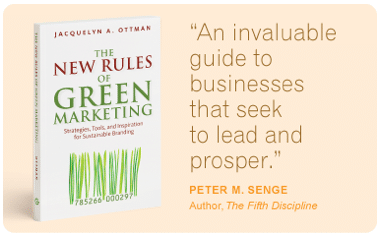
She corrected me immediately. I said that the word “Green” was losing its voracity in green marketing. Jacquelyn Ottman, author of the new book, “The New Rules of Green Marketing,” sat squarely across from me in a small booth in a deli on the upper east side of Manhattan. She looked up and said, “What do you mean? Green marketing is finally coming into its own.”

I suppose she ought to know. Jacquie, principal in J. Ottman Consulting, wrote her first of four books on green marketing in 1991. Like a witness now being cross examined by a polished pro, I forged on in the defense of my position. I pointed to how trite and trivial so many marketers have become as they half-heartedly promote their “Green” brands, and how their incompetence, and misdirected and ill-advised use of green marketing terms dilutes the entire movement. I had a lot of coffee in me that sunny St. Patty’s Day morning.

“That is precisely why I wrote the book,” she, with the calming affect of a tenured professor, said.

“The New Rules of Green Marketing” is a hybrid of text book and professional journal. I did not read it cover-to-cover on my flight out to NYC. It is the kind of book that you pick through, dog-ear, highlight and scribble in. It overflows with insightful marketing, smart case studies, and lists of references, resources and “do’s and don’ts” for successful green marketers. It now adds another pound or two to my briefcase, even when I try to shoo it away. When it appears again on my office desk or in my home den, I find myself indiscriminately opening it and learning in 5-minute chunks.

When my third cup of coffee arrived, she volunteered to sign my copy. I had to apologize for already having written all through it. I think she was glad to see the industriousness of this reader mirroring her utilitarian approach to sustainability.

Jacquie is a very wise, friendly and thoughtful marketer. Admittedly, I can get bogged down and ornery about the inane use of the advertising industry in general, and especially the short-sightedness often found in green marketers. But not Jacquie. She has one optimistic goal: “To skew the market to greener goods.” Her book is built on three themes:

  1. Product lifecycle orientation
  2. Responsible consumerism
  3. Consumer empowerment through education

If you’re a brand manager, chief sustainability officer, or ad agency consulting with a self-proclaimed “green” person, product, company or cause, then you need to read, no, wait, “own,” “The New Rules of Green Marketing.” It will give you an immediate jump on your competition through its encapsulation of decades of proven green marketing experience combined with current and relevant resources.

I can’t tell you what a treat it was to have breakfast with Jacquie in her neighborhood deli. Her new book is simply a reflection of her generosity, and although I picked up the tab for our eggs and bagels, she happily gave me some unsolicited branding advice to make me a better blogger and green marketer. And you know what else? I think she’s right about that, too.

God bless her.

Why you can’t fake authenticity in “The Now Revolution”

Social Media Arizona, SMAZ, http://socialmediaaz.org/Serendipity has a funny way of delivering us extraordinary treats.

It happened yesterday when I was reading The Now Revolution, a new book on social media by Jay Baer and Amber Naslund. The Now Revolution is an amalgam of the bottom-up management found in The Rudolph Factor, Zappo’s uber-company-culture tome, Delivering Happiness, and Chris Brogan’s Trust Agents. This social media primer provides actionable steps you can take to make real-time business work for you, rather than against you.

With social media and the connected consumer, you can’t feign passion, fake authenticity, and be complacent.

Here’s how I inadvertently put Jay to that very test.

A unique feature in the book are QR codes that you can scan with your PDA, which then immediately transport you to greater online content. I downloaded the Microsoft Tag app. on my iPhone and scanned the tag on page 16 for “The Culture Barometer;” a quiz that helps you determine the “social” culture within your organization.

But the tag kept taking me to The Now Revolution Facebook page. After three attempts, and being new to the technology, I reached out to Jay on Facebook about the errant link suggesting that it might be user error. Within five minutes, he responded  thanking me for the alert. He made a quick adjustment to the URL, and asked me to try it again. Voila!

This is The Now Revolution at work. When else could you immediately reach an author, point out a business challenge, and have it fixed within minutes? And it didn’t cost the publisher thousands of dollars in reprints and weeks of wasted time. Plus, this customer (me) became an even more active participant in the product and brand: an amazing example of the new velocity of commerce.

I jokingly suggested to Jay that he embedded this snafu to demonstrate the premise of the book: “7 shifts to make your company smarter, faster and more social.”

I’m going to miss Jay and Amber

But you don’t have to. This Friday, you can meet the authors at the Social Media Arizona event at Madcap Theaters in Tempe, AZ. I’ll be in Omaha. But if I was in the crowd, and after reading The Now Revolution, I’d ask:

  1. I can appreciate the pragmatic use of QR codes for companies and causes that can deliver meaningful content. But how can marketers avoid making them annoying promotional gimmicks, and therefore diluting the technology’s credibility?
  2. What level of manager or executive typically drives the cultural shift needed for large organizations to adopt social media?
  3. Besides Yammer, what are the top three internal social media platforms, and have you heard what SharePoint is doing in this space?
  4. Who is moving faster to learn, adopt, and activate B2B social media: Ad agencies, PR firms, or internal corporate communicators?
  5. What is the single greatest fear an organization must overcome to be successful with social media?

If you haven’t ignited your own social revolution inside your company, then the time is NOW to start by attending SMAZ.

Don’t put off reading this post.

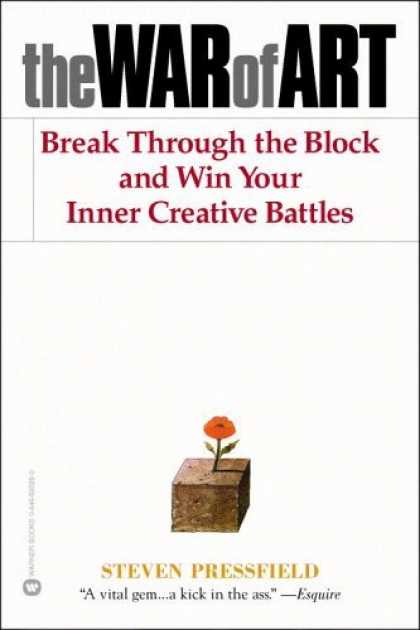
I’ve been putting off writing this post for a long time. The resistance has been strong. But given that it’s a new year, and all of our resolutions are on the table, the time is now to tell you about “The War of Art.”

Steven Pressfield’s book about breaking through the blocks and winning your inner creative battles explores our self-doubt, procrastination and laziness that is the holy trinity of resistance.

No matter what profession you’re in, it’s the artist within each and everyone of us that unlocks our success. “The War of Art” examines resistance in bite-sized one- and two-page chunks exploring all of the ways we thwart ourselves, primarly out of fear of success and failure.

Despite the topic, this is a fun read, written by a fabulous screenwriter and author, that should be stuffed in everyone’s brief case and revisited often for quick refreshers on how to cross the finish line with every endeavor we set  into motion.

How to coax excellence out of you and your team found in new book: “Coach to Win the Leadership Game”

Pete Walsh, Master Certified Coach

My friend, Pete Walsh, is plagued with an occasionally wicked slice from his left-handed golf swing. Yet, it never gets him down. He has the mental tools and insight to work on his weaknesses in the fairway, while accentuating his strengths around the green.

He’s a competitor.

The best thing about Pete? No matter how far he cranks it out-of-bounds, he’s always having fun and looking forward to the opportunity that comes with his next shot.

This is not only how he takes on coaching in the business world, it’s how he approaches life.

Buy your copy at Amazon by clicking here

Pete is a master certified coach, and he brings the same discipline demonstrated in every winning sports team to his clients’ offices. He’s worked with Park&Co for several years, coaching everyone from our front office person, to me. He makes me a better person, player AND coach to my people.

When I blow it, he’ll come in and say, “I’ve got to punch you in the nose on that one, pal. What were you thinking?” Then he helps me find positive ways to fix my swing and holds my feet to the fire to be accountable to myself and to my team.

The foundation of his corproate coaching is his proprietary P.A.C.E program, which stands for:

  • Percieved need: Unearthing the gap in behavior that needs to be closed or corrected
  • Analysis: Understanding how the behavior impacts both the person and the organization and how it might be remedied
  • Commitment: Making a commitment and being accountable for your change
  • Execution: Taking action and being there as a coach to cheer on your employee at the finish line

I’m proud of Pete, because in celebrating his 10th anniversary in business, he is sharing his program in his new book, “Coach to Win the Leadership Game,” Accelerate team development and inspire accountability to win in the marketplace.

I loved the “20 Traits of a Coaching Leader” he outlines in his book, and the practical ways he applies proven coaching techniques to win in business.

You can buy Pete’s book on Amazon.com, or contact Pete at PeakCoach.com. You might not want any of his golfing tips, but he’ll definitely improve your game in business, and in life.

Congratulations, Pete.

The 15 characteristics of “Rudolphs” and how they can help steer your company thru the fog of the recession

Image by Tony Wellington

This economy certainly has companies looking inward. Just to survive, let alone be sustainable, means questioning every practice and how you do business. We have built our agency primarily on outward bound advertising campaigns that we call marketing movements.

Now Park&Co is being tapped to help organizations with their intenal communications programs. They’re not looking for your typical H.R. storyline. Clients are asking for as much creativity and disruption with their internal campaigns as you will find with award-winning ad campaigns.

These employee-centric campaigns have me digging into a whole new realm of business and motivational books to help us find ways to create messages that are relevant and compelling to the individual worker.

Derrick Mains of Green Nurture recommended, The Rudolph Factor, Finding the Bright Lights that Drive Inoovation in Your Business. The book is a case study about the remarkable turn-around Boeing mastered by applying the leadership principles of the Rudolph Factor to their C-17 plant in Long Beach, California.

What we have found is that human nature tends to promote the vision of the machine without demonstrating why it matters to the goals and dreams of the individual employee. The overiding premise of the Rudolph Factor is.

“Leadership, in its most rudimentary form, is all about, and only about, connecting people to their future.”

One of the surest ways to drive innovation and promote employee buy-in is to marshall the forces of your internal “Rudolphs.” Rudolphs make-up about 10 percent of every organization. They’re just as likely to be on your shipping dock, in engineering, or found in a bright secretary, as they are in the C-suite. Tapping their innate inovative ways is essential to building a sustainable organization.

So what do the look like? According to the Rudolph Factor:

  1. Rudolphs are naturally creative, and often appear eccentric to the their co-workers
  2. They solve problems in unconventional ways and love to get their hands dirty
  3. Rudolphs spend an average of four to six hours per day outside of work thinking about ways to better the organization
  4. They are extraordinarily passionate about their work
  5. They often ask, “Why?” even when it makes others around them uncomfortable
  6. They question the status quo and challenge their colleagues to think outside the box
  7. Rudolphs see possibility, opportunity and potential, usually creating nontraditional or unconventional opportunities
  8. Although they enjoy it, Rudolphs are not motivated by self promotion
  9. They are adept at connecting the dots that others do not see to solve problems and make improvements
  10. They are systems thinkers seeing the whole forest rather than a single tree
  11. Although they think like an entrepreneur, they do not want to run their own businesses
  12. Rudolphs prefer collaboration
  13. They have the ability and confidence to turn their ideas into action
  14. They often act on an idea before they know how it can be done (My father always told us, “Do something, even if it’s wrong.”)
  15. Rudolphs do not rely on convention to get things done, and they often appear as trailblazers, troublemakers, or loose cannons to non-Rudolphs

If you find yourself redefining how your company or organization can fly through the fog of the recession and become more sustainable, I highly recommend “The Rudolph Factor.” What book would you recommend to add to my library on internal communications and motivation?