ParkHowell.com

Posts Tagged ‘Goodwill’

Is your neighborhood donation bin laundering your clothing to for-profit retailers?

“Clunk, slam!” is the hollow thanks you get when a collection bin devours your donated items. You may think that the sack of clothes you just stuffed through the metal orifice is going to help a charity. Chances are, it won’t. More likely, your kind contribution will line the pockets of a for-profit thrift operator.

There is no real donation involved – presenting something as a gift, grant or contribution – although the for-profit entity that hoodwinks you out of your items would like you to think so.

Inside Edition just aired this story on Bruce Binler, a Long Island, NY businessman who owns hundreds of clothing bins that masquerade as non-profit collection points. It is despicable that they can intercept your donated items for their own gain that would otherwise help put people back to work, as in the case of Goodwill of Central Arizona.

Since the for-profit collection bins have appeared in Arizona, Goodwill of Central Arizona has seen its volume of donated items drop by 40 percent, from 130 pounds-per-donor to approximately 72 pounds. With foresight, Goodwill has increased its number of donors; they’re just dropping off substantially fewer items per trip.

If Goodwill had not experienced the drop in per-donor volume, they could be serving 70,000 Arizonans, instead of the admirable 35,000 they currently serve, to help find jobs. Goodwill attributes much of this loss to for-profit bins.

More than 5,000 profit-seeking bins dot the vacant corners and parking lots of the Valley of the Sun, often illegally because they appear in the dead of night without the permission of the property owner. They are here to compete with legitimate non-profit organizations for your valuable castoffs. But unless these bins have a reputable nonprofit prominently displayed on them, like Goodwill, Valley Big Brothers and Big Sisters, St. Vincent De Paul, or the Salvation Army, you can bet your donated items are headed to a bulk buyer and sold out-of-state or overseas. Very little of the money from your once beloved items will remain in the local community to help put people back to work. It goes to men like Mr. Binler.

Donation bins, like this one from Campus California, have come under fire.

But he’s not alone. Other organizations, like Campus California, which has come under intense scrutiny in the Bay Area, are doling out 200 “cause-oriented” collection bins throughout Arizona.

It’s no wonder that competition for your resale items has gotten nasty. According to the Association of Resale Professionals, resale is a multi-billion dollar a year industry that has grown by seven percent each of the last two years.

Profits are driving unscrupulous marketeers to invade the historical retail domain of non-profits and pirate your items with the false promise that they will have a significant impact on an important social cause.

So the next time that collection bin slams shut on your donated items, think again where it actually might be headed and who is truly benefitting.


Success at being “green” starts with consumer convenience

Why do you think people donate their stuff to Goodwill, the ultimate green recycling operation?

Is it because Goodwill’s workforce development programs are a great cause, and they know that the sale of their used items will help put people back to work? Or perhaps it’s because they know their used clothing and household items will help families that are less fortunate, especially in this rough economy? Or by donating to Goodwill do they feel they are doing their part to keep their items out of landfills?

Although altruism is an important motivator, the proximity of stores and ease of dropping off donations drop are the top reasons people donate. In short, it’s all about convenience.

Click to hear the bag.

Click on the image to hear the bag.

Another great example is Frito-Lay. They created a marvel, one of the first compostable consumer packaged goods bags for their Sun Chips. Did consumers embrace this remarkable innovation? No, they repelled from the noise it made. Forget what it does for the planet. The loud rustling of the bag, the first brand touch point for consumers, was just too obnoxious for most Sun Chips fans.

This unexpected sensory experience was, in its own way, too inconvenient for consumers and they stopped buying the product.

Forget about the deliciousness of the chip, it being a healthier alternative to other snack items, the renewable energy used to create it, and it’s overall “Greenness.” The sound the bag made trumped all of those brand benefits in consumers’ minds, or ears. Frito-Lay had to pull the compostable bags to, ironically, insure the sustainability of their product.

They have recently launched a new, quieter compostable bag.

Where have you seen consumer convenience trump all other aspects of a green product or service?

Advertising innovation begins with being “Ingeniously disruptive”

“What does innovation in your industry mean to you?” was the question the video producer threw at me. Tough call. Being in the advertising business – the world of “creativity and commerce” – we have to find ways to be innovative every day. It’s part and parcel of our success.

The question originated because Park&Co is among the ten finalist for the Phoenix Chamber of Commerce IMPACT Awards. The chamber is producing a short video on each company for the May 19th award show. So we have to look sharp, sound smart, and be really, really innovative.

I suppose my best answer is found in our recent ADDY Award winning work. No, this isn’t going to be a puff piece on Park&Co. It’s just the best way to answer the producer’s question.

To us, innovation is about HOW we communicate to consumers through being “Ingeniously disruptive.”

We turned Tempe’s Mill Avenue into a catwalk and pedestrians into super models for a word of mouth campaign for MadCap Theaters: Gold ADDY

MadCap Theaters, Tempe, Park&Co, word of mouth marketing campaign

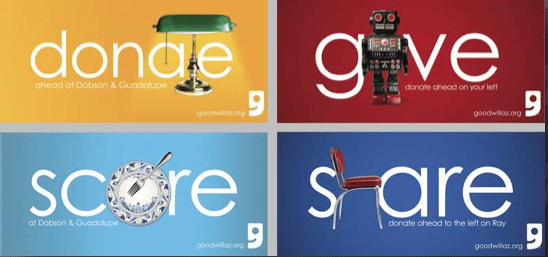
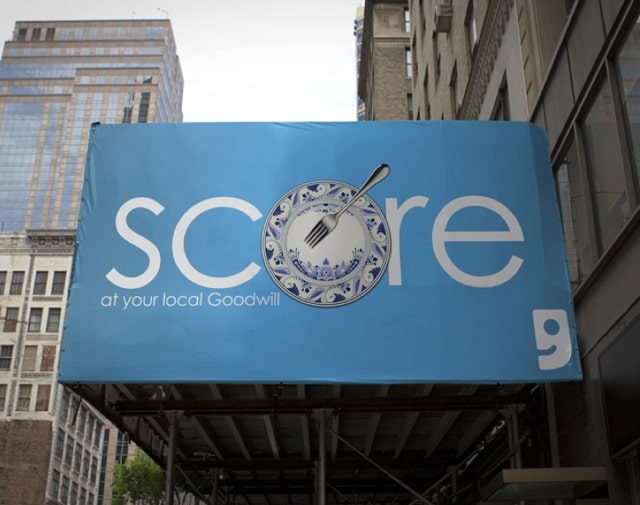
Words are worth a thousand pictures for Goodwill of Central Arizona’s outdoor and print campaign: Gold and Bronze ADDY’s, and just won a regional Silver ADDY.

We used gripping design and a twist on the navigation conventions of the web in the Halle Family Foundation website to dare visitors to “Ignore” or “Fix” social justice issues surrounding women and children: Gold ADDY

We created letters out of smashed car parts and the personal items you might find at traffic accidents to draw attention to Metro Light Rail’s “Stop on Red” campaign: Bronze ADDY

What I’m most proud of is that it wasn’t one or two ads that won a ton of awards. We won six ADDY’s with five different clients in a variety of media: WOM, web, print, outdoor, train wrap, and video.

So that’s what innovation means to us and how we practice every day in the advertising/communications/sustainable marketing world. What does it mean to you and how do you show it?

Sustainable Storytelling: How a Word is Worth a Thousand Pictures

 Click here to see the creative behind Goodwill of Central Arizona's new outdoor campaign

Click here to see the creative behind Goodwill of Central Arizona's new outdoor campaign

When was the last time you found something shopping and mentally yelled, “Scooooooooore!”? You pictured yourself  knifing your arms above your head like a Super Bowl ref signaling a touchdown. You did a silly little, “Uh huh, that’s right, I’m bad” dance between your ears.

We all know the feeling.

It’s those emotional cues that prompted our new outdoor campaign for Goodwill of Central Arizona. We married one item with one word to conjure up a thousand rewarding pictures in the minds of those who donate and shop at Goodwill.

Goodwill Transit ShelterMore importantly, it’s designed to create a snapshot of possibilities in the craniums of those who don’t.

The campaign not-so-subtly nudges you to take action. Donate. Shop. Go  hunting for one-of-a-kind treasures at Goodwill. It implores you to frequent Goodwill so that your items and cash can help with their mission of putting people back to work.

And it’s a sustainable story too, because…

  • By taking ALL of your donated items, Goodwill keeps thousands of tons of discarded stuff out of landfills and give them news lives with people who can really use it
  • If they don’t sell it, they’ll recycle it
  • The sale of your stuff goes to sustaining the training and employment of thousands of people
  • The community is sustained by the Good work of Goodwill

Think about the last time you were at a Goodwill either dropping off donations or shopping. What is the one word and the one item that best tells the story about your experience? For more ideas, you can tour the entire campaign here.

Putting Faith in Carbon Offsetting is a Bit Like Grabbing an Electric Fence

Photo by Obskura

Photo by Obskura

Ever since we announced our agency was working toward becoming carbon-neutral, we’ve received both cheers and jeers. Some call us “forward thinking.” Others call us “ignorant” for taking part in the carbon credit “racket.” Which, of course, reminds me of a story.

Our son Caedon, (he’s not ignorant), who turned 16 yesterday, has always been headstrong. He learns by doing, like grabbing an electric fence to see what happens.  The conversation went something like this when he was five-ish:

Caed: Dad, what’s that?

Me: It’s an electric fence.

Caed: What’s it do?

Me: It shocks the cattle to keep them from running through grandpa’s fence.

Caed: What would happen if I touch it?

Me: It would shock you.

Caed: (Starting to extending his right hand toward the fence) You mean, if I touch it I will get shocked just like the cows?

Me: Yup.

Caed: (Pointer finger now outstretched heading for the fence as if it’s under the spell of the Death Star’s tracker beam)  So…if I touch it I’m going to get…

BZZZZZZZZZZZZZZZZZZ!

He pulled away with a jolt, and his eyes appeared up at me in amazement as if they were saying, “Cool, now I know what a cow feels like trying to escape.”

I suppose our boy Caed is an awful lot like me. I need to experience things to really understand them. We’ve been working to make our agency more sustainable for the past 18 months, and by sustainable I mean socially, economically, culturally and environmentally. The list of how we’ve stepped up our environmental effort is below.

How We’re Learning About Carbon Credits and Offsetting

It’s a learning experience. That’s why we decided to work with EcoAid to help us calculate our carbon emissions and purchase carbon credit offsets to do our part. Is it a scam? We’ll find out, but I don’t think so.

In a May 30 article, “Carbon Offsets: A Small Price to Pay for Efficiency,” The New York Times wrote:

“Dozens of companies, nonprofit and for-profit, sell carbon offsets, and some critics question how their work can be verified. But with various certification programs now in place — including the Gold Standard and Green-e Climate, to name two — there is no reason that fraud should be harder to curb in carbon-offset markets than in other domains.”

EcoAid is a member of Voluntary Carbon Standard, which, according to the organization’s site, “…provides a robust, new global standard and program for approval of credible voluntary offsets.” As for the Chicago Climate Exchange, where our carbon credits are purchased, here are the groups that verify their programs.

By being willing to grab the electric fence and actively participate”first hand” in carbon offsetting, we’re doing our due diligence the best way we know how. By DOING. And I promise to keep you posted every step of the way. That way you can determine if this approach is right for you, and perhaps more importantly, is it going to work for commerce and ecology.

So far we haven’t been shocked.

Here are the other efforts we’ve undertaken to reduce our cost of consumption.

Recycling Program

We host a Goodwill donations bin in our parking lot to help recycle items and put people back to work through their programs.

We host a Goodwill donations bin in our parking lot to make it convenient for our neighbors to recycle items and help put people back to work through Goodwill programs.

  • Recycling bins in every office
  • Two large recycling bins located in courtyard
  • Recycling of: aluminum, plastics, paper, cardboard boxes, copy paper, letterhead, computer printout, colored papers (pastels, carbonlese, Golden Rod), envelopes (white/pastel plastic windows, no adhesives), coated papers (fax, brochures, advertising, direct mailings, file Folders (manila or pastel only NO LABELS), cardboard boxes, plastic bottles, aluminum cans
  • Goodwill donations bin on our property

Repurposed Furniture

Rather than buying new, we refurbished old flourescent lights with new energy-efficient balasts.

Rather than buying new, we refurbished old flourescent lights with new energy-efficient balasts.

  • Feature repurposed old furniture throughout office
  • Lighting fixtures
  • Filing cabinets

Copy Paper

  • Beginning Sept we will be purchasing copy paper that is 33% post consumer waste
  • Printing program, printing on both sides of paper, continually reducing our paper waste, only print what you need
  • Production/Status reports are all electronic

Toners/Ink Cartridges

  • Recycling of all HP laser cartridges
  • Epson Ink cartridges
  • Purchasing remanufactured B/W laser cartridges
  • XEROX new brand, 27% overall savings

Sustainable Cafe

  • Energy efficient microwave
  • Energy efficient dishwasher

Water Conservation

  • Run the national Water – Use It Wisely Campaign
  • Water filtration system
  • Water cooler system via filtration

Opted Out of Junk Mail

  • Direct mail
  • Catalogs
  • Phone books
  • Newspapers

We’re meeting this afternoon with a group to do an energy audit on our building. We’ll also be hosting SolarCity to determine the viability of adding solar to our 10,700 square foot building. We’ll keep you posted.

Thinking back on Caed and the electric fence: I’m glad he didn’t ask what would happen if he peed on it. You don’t want to know.