ParkHowell.com

Posts Tagged ‘Goodwill of Central Arizona’

New TV spots for Goodwill of Central AZ explore your donation options

The heros in our new 30 second TV spots for Goodwill of Central Arizona are people donating their clothing and household items. We follow their journeys navigating the many tempting options to dispose of their goods, including the convenience of throwing them away or dumping them in curbside donations bins – many owned by questionable for-profit entities that take your items out of state.

Our first spot follows a boy as he finds a new home for his Teddy Bear. The second spot features empty-nesting parents as they collect the items from their grown daughter’s room and relive the memories. Michele and I can especially relate to the second spot, having two of our three kids now on their own.

The theme throughout is that you have choices when giving away your clothing and household items, and we’re hoping you will choose to donate them to a nonprofit that will put them to good use helping others. Obviously, we would like your story to conclude at Goodwill.

Did you know that 90 cents of every dollar worth of items you donate to Goodwill funds workforce development programs that help put people to work in your community?

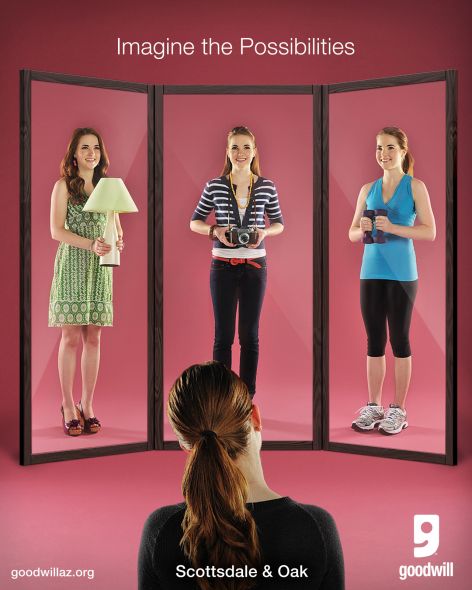
We’re also pleased that the print portion of this campaign is featured on Ads of the World.

What is your Goodwill journey? What treasure have you found and what have you donated to help put people back to work?

Is your neighborhood donation bin laundering your clothing to for-profit retailers?

“Clunk, slam!” is the hollow thanks you get when a collection bin devours your donated items. You may think that the sack of clothes you just stuffed through the metal orifice is going to help a charity. Chances are, it won’t. More likely, your kind contribution will line the pockets of a for-profit thrift operator.

There is no real donation involved – presenting something as a gift, grant or contribution – although the for-profit entity that hoodwinks you out of your items would like you to think so.

Inside Edition just aired this story on Bruce Binler, a Long Island, NY businessman who owns hundreds of clothing bins that masquerade as non-profit collection points. It is despicable that they can intercept your donated items for their own gain that would otherwise help put people back to work, as in the case of Goodwill of Central Arizona.

Since the for-profit collection bins have appeared in Arizona, Goodwill of Central Arizona has seen its volume of donated items drop by 40 percent, from 130 pounds-per-donor to approximately 72 pounds. With foresight, Goodwill has increased its number of donors; they’re just dropping off substantially fewer items per trip.

If Goodwill had not experienced the drop in per-donor volume, they could be serving 70,000 Arizonans, instead of the admirable 35,000 they currently serve, to help find jobs. Goodwill attributes much of this loss to for-profit bins.

More than 5,000 profit-seeking bins dot the vacant corners and parking lots of the Valley of the Sun, often illegally because they appear in the dead of night without the permission of the property owner. They are here to compete with legitimate non-profit organizations for your valuable castoffs. But unless these bins have a reputable nonprofit prominently displayed on them, like Goodwill, Valley Big Brothers and Big Sisters, St. Vincent De Paul, or the Salvation Army, you can bet your donated items are headed to a bulk buyer and sold out-of-state or overseas. Very little of the money from your once beloved items will remain in the local community to help put people back to work. It goes to men like Mr. Binler.

Donation bins, like this one from Campus California, have come under fire.

But he’s not alone. Other organizations, like Campus California, which has come under intense scrutiny in the Bay Area, are doling out 200 “cause-oriented” collection bins throughout Arizona.

It’s no wonder that competition for your resale items has gotten nasty. According to the Association of Resale Professionals, resale is a multi-billion dollar a year industry that has grown by seven percent each of the last two years.

Profits are driving unscrupulous marketeers to invade the historical retail domain of non-profits and pirate your items with the false promise that they will have a significant impact on an important social cause.

So the next time that collection bin slams shut on your donated items, think again where it actually might be headed and who is truly benefitting.


How we made Goodwill the Official Sponsor of Halloween

Halloween is the one night when normal rules don’t apply. When the kid in all of us gets that rare chance to be anything he or she wants. It’s also one of the biggest sales opportunities of the year for Goodwill. In the thrift industry, October is one of the largest months for sales. It’s the equivalent to Christmas for general retailers.

This year, Park&Co puts Goodwill at the epicenter of fall fun and creativity with the “Official Sponsor of Halloween”campaign. The fun and anticipation of dressing up comes not from what we can purchase off the rack, but from what we can invent with our imagination. Goodwill is much more than a place to simply buy a costume; it’s a place to discover a hundred possibilities for creating one. The elements of this campaign consist of TV, radio, print, outdoor and online executions, all depicting one simple message: most ready-made, ill-fitting, store-bought costumes are so lame, it’s almost frightening—and not in a Halloween sort of way.

The concept of the Goodwill Halloween campaign allowed us to take advantage of the creative surroundings here at Park&Co, lovingly called our “Creative Campus.” We transformed our offices into a studio for the all-day TV shoot. Our staff willingly served as extras, dressing in everything from chicken costumes to rodeo chaps. We built a “dressing room” for our main talent in the Creative Garage and held a photo shoot in our very own Combustible Kitchen. While this may seem unconventional, it made the campaign that much better as it was truly an all-agency effort.

And now that Goodwill has a whole new look for Halloween, what about you? What are you going out as this year? Better head to the Official Sponsor of Halloween pronto before someone snatches that green mohair suit before you do.

An empty box full of buzz about Goodwill of Central Arizona

I am fighting every urge to tell you the cliche of thinking outside of the box when it comes to telling your brand’s story. But we couldn’t help ourselves when we came up with this simple idea for Goodwill of Central Arizona.

Send an empty box to homeowners with directions to their nearest Goodwill donation center, and watch the word of mouth buzz fly. Renown WOM guru, Andy Sernovitz, recently featured this story on his, “Damn! I wish I’d Thought of That!” blog about unusually useful ideas for smart marketers.

Goodwill’s thrifty online marketing strategy for its new “Donate Movement”

THE most powerful brand strategy in green marketing is not  found in what you say, but in what you do!

Picture 7

Goodwill International’s new “Donate Movement” is a model of online efficiency for consumer engagement. “Waste not, want not.”

They don’t doddle around trying to explain their differentiation over other important “green” causes and sustainability programs that compete for your attention. The “D Movement” website involves you immediately by enabling you to donate and recycle NOW!

Goodwill’s new “D Movement” is a partnership with Levi Strauss to make donating a more conscious decision. Their plan is to make the “D” the universal symbol for donating, like the recycling logo is to recycling. Would you really expect anything less from America’s first real recycler?

Recycle & donate

You always hear about “Search optimized” websites. Goodwill has “People optimized” this site.

For starters, you can quickly see the impact your donations have with Goodwill’s Donation Impact Calculator prominently featured on its homepage. The three pair of jeans I just donated to Goodwill of Central Arizona will support 34 minutes of on-the-job training. The two jackets I’m not going to need in our 112 degree weather just bought 1.2 hours of training. What do you think one lamp is worth in training? See for yourself.

Goodwill’s Thrifty Social Media Strategy Includes:

  • Goodwill makes it easy to “Like” the Donation Impact Calculator by locating the Facebook “thumbs up” button as part of the calculator’s interface.
  • The site uses Google maps to help you quickly find your nearest Goodwill donation center.
  • A live Twitter feed captures on-going chatter about the campaign.
  • A real-time digital counter tells you the poundage of usable items being saved from landfills.
  • Picture 4You’re encouraged to show your support by adding the donate button to your Twitter and Facebook profile photos through the use of Twibbon. They pay you back with immediate gratification as you pop up as a “Recent supporter” on their site. Great engagement tool that compounds the reach of their campaign. Smart!
  • Goodwill invites you to join their blogger network. They request a post about why you donate, and ask that you include their donate button on your site. I’m joining, are you?
  • Make a commitment to de-clutter… and donate your gently used clothing and household items to Goodwill a few times this year,” is their last call-to-action in the support section on the Donate Movement site.

Goodwill & Levi’s Nifty WOM Promotion

caretag1All great green marketers know that a sustainable word-of-mouth marketing strategy happens both online and off. That’s why I love what Levis is doing with the campaign right in their britches.

They’ve created a care label that tells you how to have the least impact on the planet with the washing of your jeans. The final tip is to donate your Levi jeans to Goodwill when no longer needed.

What the “D Movement” means by the numbers:

  1. Goodwill diverts some two billions pound of useful product from landfills each year.
  2. The revenue generating through the resale of donated items helped 1.9 million people in a variety of industries in 2009.

What do you think? After touring their site, does it push your donate and recycle buttons, or does it push you away?