ParkHowell.com

Posts Tagged ‘sustainable marketing’

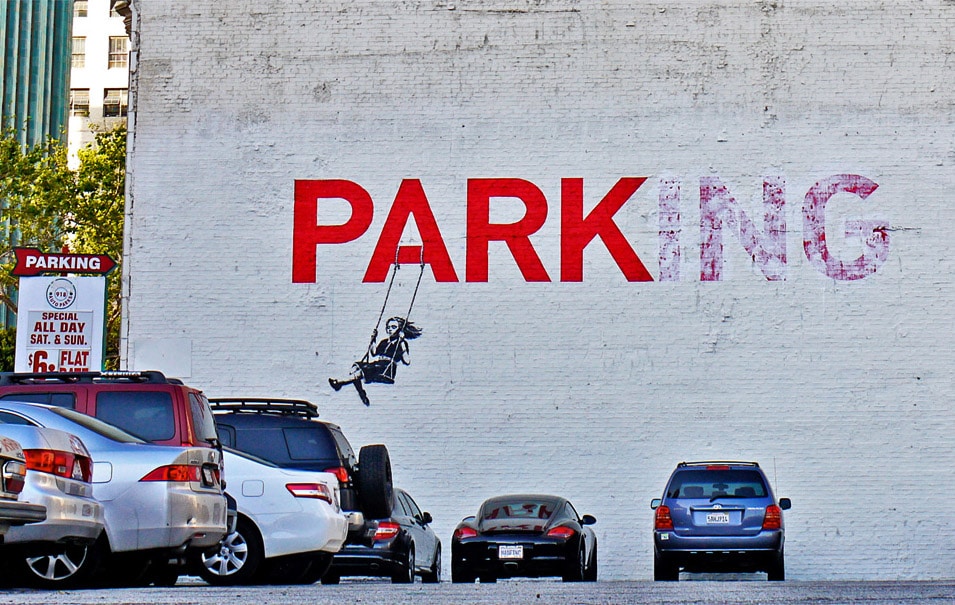
Does Banksy know that he just designed me a new logo?

My son, Caed, just sent me this image from phantom street artist, Banksy. It pretty much sums up what I’ve been writing about relative to green marketing and sustainability going on three years now…

…especially on the heels of a post I wrote last year about a new airport parking lot had the opportunity to stand for much more than paving the desert, clogging the freeways, and darkening our skies.

My premise is that opportunities to be – and educate about – being “green” and sustainable are all around us, especially if we take a youthful look at what we’re doing.  You don’t have to be a tree hugger. All you need is to tap into your innate creativity, add a little industriousness, don’t fear being disruptive, and you will make a world of difference. AND, have fun while you’re at it.

It’s so easy, even a parking lot can do it!

So stop taking yourself so seriously, and start finding surprising and productive ways to do your planetary thing.

Are You a Green Marketing Weirdo Trying to Change the Behavior of Normal People?

039_8892

Are you truly embracing your market?

Dr. Sam Ham called me a, “Weirdo.” He’s a professor at the University of Idaho who has developed an interesting approach to storytelling to provoke behavior change.

I first learned of Dr. Ham from a green marketer in Queensland, Australia. Greg Bruce is the Executive Manager of Integrated Sustainability Services for the Townsville City Regional Council down under.

He sent me a note after reading my blog, and said: “I found much of your text and content “thematically” written and thought provoking. So one conclusion is that either you have done “thematic interpretation/communication” with Dr Sam Ham… or you are intuitively as a social marketer tapping into thematic communication styles – which are opposite of the way most people (and marketers too) are taught, think, act and communicate – and I know as I deal with a lot of them (and they are not thematic communicators).”

Wow, do you think I was intrigued? So I started doing some digging on Dr. Ham. What I found is another body of work that backs up the theory that “Stories sell!”

In this case, it’s how you successfully promote behavior change in sustainable and environmental causes through the use of what the good doctor has coined, “Thematic Communication.”

In fact, I’ll let Dr. Ham do most of the explaining. Over the course of the next several articles here, you will meet Dr. Ham and learn ways to apply his approach of “Thematic Communication” in your campaigns.

Let’s start with my first question:

What is the number one mistake people make when trying to communicate or promote a particular behavior change?

Dr. Sam Ham: Professor of COmmunication Psychology, Dept. of Conservation Social Sciences, College of Natural Resources, University of Idaho

Dr. Sam Ham: Professor of Communication Psychology, Dept. of Conservation Social Sciences, College of Natural Resources, University of Idaho

Dr. Sam Ham: “The biggest, by far, is that we assume we’re representative of the people whose behavior we want to influence.  This leads us to intuit messages out of the blue and to make arbitrary choices about communication appeals based on what we think would be “influential” to us.  Research and much practical experience tells us that people like us are usually very different from our audiences in how we think and feel about things related to the behaviors we promote.

Even a moment’s reflection should convince us that if all those other people really thought and reasoned like we do, there would be little need to persuade them of anything.  They’d already be behaving like us.

A further caveat here is that since “all those other people” outnumber us, that by definition makes them “normal.”  So we have to face the reality that we weirdos (in the statistical sense) have taken it upon ourselves to make normal people more like us.  Just a thought in the name of ethical humility.”

A good example of this communication deficit between the “Weirdos” and “Normal” people is seen the 1968 movie, “Planet of the Apes.” Charlton Heston’s character, Ulysse, crash lands his space ship on a far flung planet that greatly resembles Earth. Ulysse, in the world he came from, is of course the dominant species. However, he discovers in the upside-down world he now inhabits that humans have been reduced to ape-like beings, while the apes run the place. Ulysse, according to my loose interpretation of Dr. Ham’s thesis above, represents the green marketer. The apes are the market. It’s not until Chuck gets in the heads of his ape captors-soon-to-be-patrons, that his survival is assured.

I suppose the same holds true for any marketing effort.

As marketers, we often think we have all of the answers – we’re the normal ones – even as we haven’t taken the time to hear the important questions posed by our customers. We become bloated with industry jargon and tech speak, when what we really need is a good tale that reveals the truth about our cause and why people need to act. Only then, through understanding that comes with thematic communication, will we be effective and sustainable.

Ok, so Dr. Ham didn’t call me a “Weirdo” directly to my face. But I’ve been guilty of the “Know-it-all” marketing syndrome he references above.  Have you?

In my next post in this series, we will unveil the character of thematic communication through the eyes of Dr. Ham with great examples of how it works.

The Route to Success for Phoenix Metro Light Rail’s New Creative Campaign

Jazz PlayerPhoenix Metro Light Rail left the station for the first time around this time last year. It was one of the most successful light rail launches in the country, with more than 200,000 people flooding the 28 new stations along the 20-mile route.

Although we can’t lay claim to Metro’s overall success, we are proud to have played an instrumental role in its branding: “Your Life on Track.”

Now we have a new campaign hitting the streets. I’ve asked our art director, Shawn Hardy, to tell you a bit more about the creative process in creating this beautiful poster campaign.

Basketball player“In concepting the ASU venue posters, we wanted to focus on specific activities and places that METRO light rail puts on track throughout the Valley. Simply mentioning or showing all these would become very dull very quickly and wouldn’t portray METRO light rail as a modern alternative mode of transportation.

The challenge became how to depict activities in an engaging way that would tie them directly to light rail. The answer came from the symbolism found in your route map—common to almost all subway and rail maps. The colorful, curving lines of these maps make an ideal brush with which to paint or symbolize the lifestyle that is now available on track via light rail.

Ballet DancerFrom live music to museums; from sports to shopping; from dining to stage shows—almost any experience or venue can be colorfully created and instantly linked to METRO light rail through the use of these track lines. This instant brand association gives the concept enormous versatility for use in a wide variety of MLR messaging and branding. The simple, colorful symbolism lends itself well to all visual media, including print, outdoor, TV and web. And because photography or detailed illustrations aren’t needed, the artwork is relatively inexpensive to produce.”

Shawn Hardy, Art Director, Park&Co

Carl Sagan and Stephen Hawking Rock in “A Glorious Dawn:” Astrophysics in 4/4 Time.

Melodysheep created this ethereal musical tribute to two rock stars of the universe: Carl Sagan and cosmologist companion Stephen Hawking. What’s really cool is that almost all of the samples for the track were taken from Sagan’s Comos and Hawking’s Universe series.

What’s the point for your green marketing and sustainability messages? Think outside of the wormhole and get creative in how you talk about heady stuff. You’ll appeal to the common physicist in all of us.

“High Speed, Low Drag,” and 13 Other Tips to Running a Sustainable Business in this Economy

Google: "I'll raise you a rabbit"

Google: "I'll raise you a rabbit"

I was blessed with the name Park. It gets attention. No, I’m not Korean. And in some future post, I’ll tell you where it came from.

For now, I thought I’d give you a little more background on the guy behind the name. The following are my responses to the Phoenix Business Journal’s “2 Minutes With” section that just ran.

Does that mean I only have 13 minutes of fame left?

And of course, all of my best lines ended up on the cutting room floor (I guess you can be the judge of that), so I’ve included my entire  interview here.

What advice do you have for entrepreneurs just starting out?

I like the famous photographer’s line, “F8 and be there.” You don’t have to be an incredible business mind to be successful, just like you don’t have to be a world renowned photographer to take great pictures.  You just have to show up everyday, give it your all, and keep it simple.

What is one of your business goals for 2009?

We’re going to grow Park&Co by 10 percent this year due to our work in green marketing and sustainability.  We call it “Responsible Marketing,” and the timing couldn’t be better, given the growing economic and environmental sensibilities of the market.

How have you changed your business strategy to reflect current economic conditions?

We took a page out of the survival manual from Arizona Mountain Rescue: “High speed, low drag.” This perfect economic storm is an IDEAL environment for our agency – and our clients – to capture market share that is often more difficult and more expensive to do in bull markets. We are more efficient and nimble than ever with our staff, operations, and bringing campaigns to market. We look for and work with clients that are driven by realistic opportunity and not fear.

What resources did you use to help develop your business and marketing plans?

Fortunately, this cobbler’s kid has shoes, and pretty nice ones too. We rely on our brilliant staff for our own marketing strategy and creative. We also work with outside consultants, like Pete Walsh of Peak Performance Coaching, to test our assumptions and plans.

How do you use technology, i.e., social media, Internet marketing, etc., to promote your business?

Technology and internet marketing is a tactic, not a strategy. We always tie our online digital footprint – Blogs, Facebook, Twitter, Pay-per-click campaigns, organic search, Ning groups, etc. – to tangible, in-person marketing so customers can experience us real-time, not just virtually. I also write this blog called “A Brighter Shade of Green Marketing,” at ParkHowell.com. This is a great way for potential clients to get a better understanding of how I, and the agency, approach sustainable, responsible marketing.  You’ll find a lot of free advice there.

How do you recruit and retain quality employees?

We recruit quality employees by a very selective word of mouth and referral program.  We retain them by respecting and appreciating what they contribute to the team.  And we challenge them to do their finest work here; in an accountable environment that promotes their personal and professional growth.

What is a significant goal you achieved in the past 12 months?

We have dramatically increased our online marketing and social media capabilities, and have experienced tremendous results combining this virtual world with real world word of mouth marketing for our clients.

What is the biggest challenge you’ve overcome in growing your business?

Getting out of the way of our talented team. I love rolling up my sleeves and diving into strategy and creative challenges for our clients. But I am surrounded by an insanely talented group of pros, and I need to give them the freedom to do what they do best.

Do you have an exit strategy or a succession plan for when you retire? What is it?

Besides driving my business into the ground through a series of ridiculous and avoidable blunders and waiting for the government to bail me out, I haven’t found a succession plan I like yet.  Too young, I suppose.

Did you ever want to call it quits? If so, why, and what stopped you?

No, I can’t say I ever wanted to call it quits. I don’t have enough dough to retire, and I can’t see myself in a corporate environment. I tend to be a free thinker and like to push our clients beyond their comfort zone to help them grow. These are qualities that often go unappreciated as an employee.  Plus, I can’t color inside the lines very well.  Never have.

What do you know now that you wish you had known when you started your business?

Numbers and Little League coaches often lead to unrealistic expectations. It’s actually impossible to give 110 percent. Ninety percent effort with concerted thought is typically 20 times more than what most businesses offer 60 percent of the time.

How do you market?

We market our traditional and nontraditional advertising services through social media, online marketing, and in-person workshops and presentations. We seek out and ignite the growth of those people, products, services, and businesses that are having a measurable positive impact on our planet.

What mistake have you learned from?

When I started Park&Co in 1995, I tried to be all things to all people. Then we began doing a lot of work in sustainability and cause marketing long before green became cool. This focus is a reflection of the first of our seven operating tenets: “Run a profitable, socially conscious company.” Given the current global economic and ecological meltdown, the market has found us in a big way. Find your niche, and if you don’t, sometimes it finds you.

What’s the best piece of business advice you ever received?

Actually, I have two “Best pieces of business advice” that came from my Dad: “A deal is only good if it’s good for both parties,” and “Make more than you spend.” which is pretty good advice these days.

Do you have a question for me? Please ask in the comments form below, or shoot me a note from my contact form.